Category:

Blog

Has Video outgrown your DAM?

Digital Asset Management systems sit at the heart of most marcoms operations. They centralise content, organise it, and make it discoverable. Integrated with the wider MarTech stack, DAM support governance and drive efficiency. But video has changed the brief.

Video is no longer an occasional campaign asset. It is now the dominant content format across marketing, product, internal communications, and customer engagement. And as volumes grow, so do the operational pressures.

The issue is not whether your DAM can store video.
The issue is whether your teams can discover, reuse, adapt, and govern it efficiently at scale.

Because when discovery slows, reuse drops.
And when reuse drops, costs rise – often without anyone noticing.


Video Is ‘Just Another File’ – Until It Isn’t

At a basic level, a video file is simply another digital asset. A DAM can store it, catalogue it, and apply metadata to it. But video carries characteristics that fundamentally change how it needs to be managed:

  • Format complexity. Video comes in a wide range of encoded formats (CODECs), each with different configurations – frame rates, encoding structures, audio arrangements. These aren’t cosmetic differences; they directly affect compatibility, quality, and approach to distribution.
  • File size and accessibility. Professional video files are large and often not web-browser compatible. That makes previewing, streaming, and collaboration harder within systems designed primarily for static media.
  • Time-based structure. Unlike images, video unfolds over time. Metadata doesn’t just apply to the whole asset – it applies to specific periods within it.
  • Localisation and variants. Subtitles, audio stems, regulatory edits, regional variations – these are related and often interdependent components, not just new versions of the same file.
  • Derivative creation. Social cutdowns, vertical edits, different durations – all need to maintain lineage back to the master asset to avoid duplication and rights infringements.
  • Ongoing editing cycles. Video assets are routinely adapted long after creation or first publication. Their lifecycle is longer, dynamic and continuous.

And perhaps most importantly, Creatives and marketers are rarely searching for a file.
They are searching for a moment – a product shot, a quote, a scene, a reaction. That distinction is where traditional DAM models begin to strain.

Finding the Right Moment – Not Just the Right Asset

Metadata has always powered discovery inside DAM systems. This object-based metadata – be it campaign, product, spokesperson, usage rights – works well when assets are static.

But video exists in two dimensions:

  • Catalogue metadata – information about the asset as a whole.
  • Temporal metadata – information tied to specific time periods within the asset.

A tag might say “Product X is in this asset,” but it won’t say whether that appears in the first five seconds or the last thirty. It won’t tell you if the segment you want to use is already in use elsewhere, or the rights have expired. That lack of clarity increases risk and kills efficiency.

At a small operational scale, teams can compensate with knowledge (memory), spreadsheets, and manual review.

At enterprise scale – across regions, agencies, languages, and campaigns – that approach quickly breaks down.

When discovery doesn’t deliver, teams instinctively create their own workarounds: local edits, shared folders, private versions – bypassing the DAM because it doesn’t give them what they need when they need it. That behaviour isn’t just inefficient, it erodes governance, inflates production costs, and reduces RoI from existing content.ntent.

The Hidden Cost of “Making It Work”

Most modern DAM platforms support video in some form. Many do so capably within the limits of their original design. But “supporting” video often means adapting workflows around a model designed for static assets.

That adaptation typically looks like:

  • Additional tools bolted on around the DAM
  • Manual reformatting and distribution processes
  • Workarounds for preview and playback
  • Fragmented metadata across systems
  • Disconnected rights tracking

Individually, these compromises feel manageable.
Collectively, they create friction — and friction increases exponentially as content volumes grow.

Managing Video Requires a Shift in Perspective

The real question isn’t: “Can our DAM store video?” It’s: “Are we managing video on its own terms?”

What’s emerging is not a rejection of DAM, but a more nuanced ecosystem:

  • DAM remains essential for governance, brand control, and enterprise-wide visibility.
  • Video-native systems handle time-based metadata, format complexity, version control, and high-volume processing.
  • Integration ensures both operate cohesively rather than competitively.

Savvy teams are not looking for a monolithic “silver bullet.” They are rethinking their architecture so that each specialised system – DAM, video indexer, transcoder, rights engine – contributes a distinct capability. The task then becomes enabling systems to collaborate, not forcing one to do everything. That mindset separates high-performing teams from those stuck patching processes.

Lessons from Media & Entertainment

These challenges are not new.  The Media & Entertainment sector has been solving them since the late 1990s through Media Asset Management (MAM) systems. For broadcasters’ manual processes were never viable.

Operating efficiently required:

  • Structured, time-aware metadata
  • High levels of automation
  • Tight integration between production and business systems
  • Clear orchestration across ingest, edit, versioning, and distribution

As corporate video demand begins to reach broadcast volumes, marcoms teams are encountering similar pressures, often without the infrastructure on which professional media organisations rely.

Automation Is No Longer Optional

With content demand chains growing exponentially, manual operations are becoming infeasible – even for mid-sized With marcoms content demand chains growing rapidly, manual operations are becoming infeasible – even for mid-sized teams.

Video management at scale requires orchestration:

  • Automated transcoding into multiple formats
  • Structured version control
  • Omni-channel distribution
  • Integrated rights and compliance management

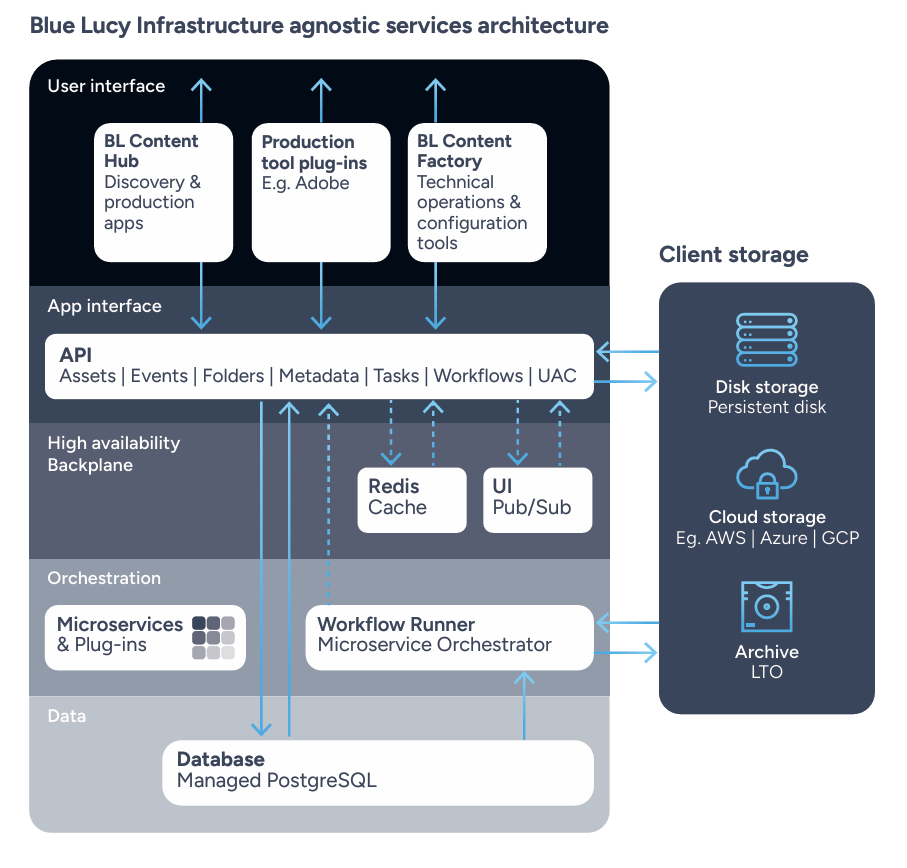
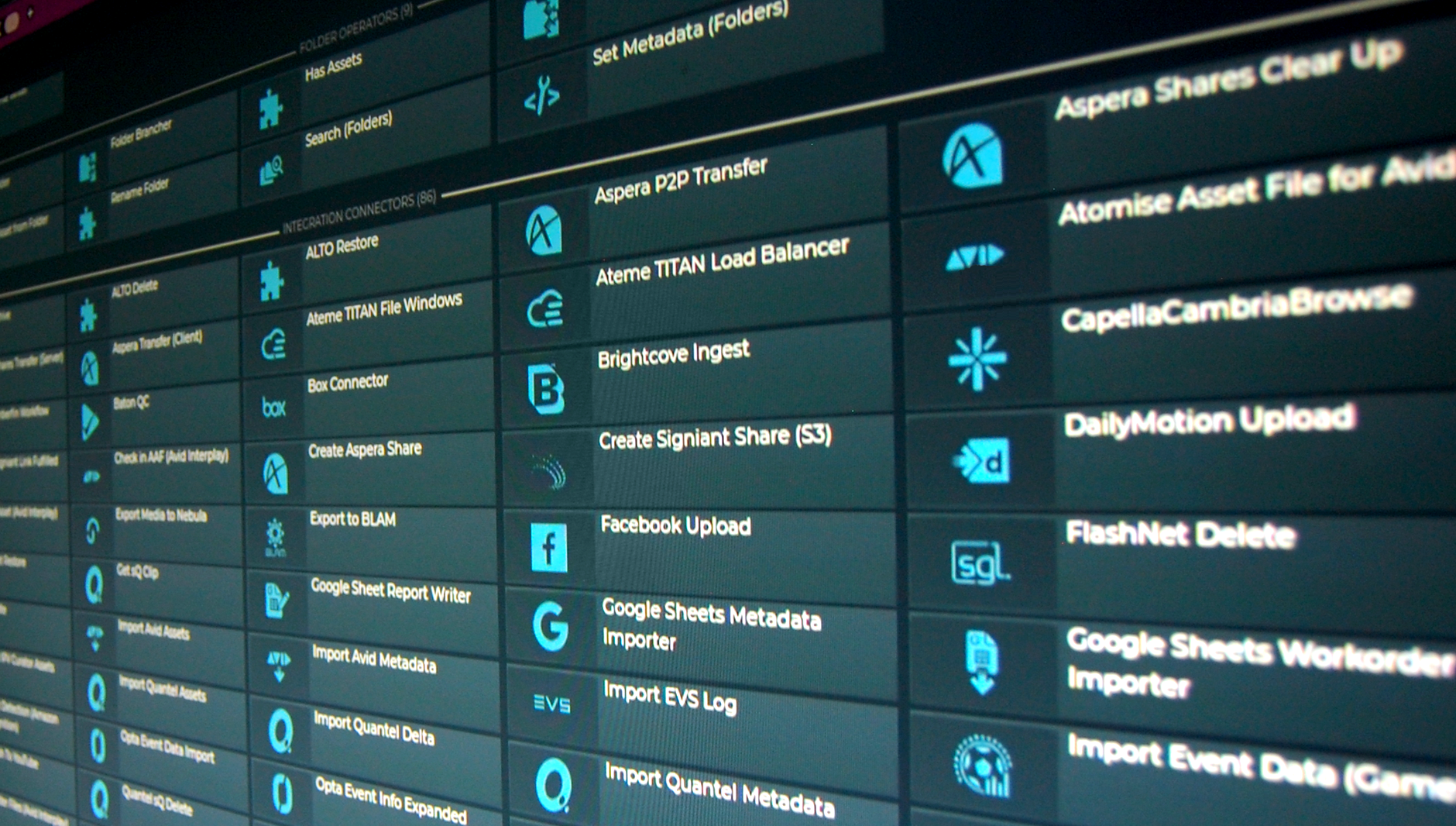
Adjacent to automation is the need to reduce friction between systems. Modern media systems such as the Blue Lucy platform are built with structured integration frameworks designed to connect production tools, DAMs, and business systems efficiently.

Because the real risk isn’t just storage capacity.
It’s operational complexity, and the erosion of value from content you’ve already invested in creating.

The Real Challenge

Video is now the dominant marketing medium. Storing it is easy. Managing it intelligently – discovering moments, reusing content, coordinating derivatives, and maintaining governance at scale – is the real challenge.

Organisations that recognise this shift early are building integrated, automated video operations designed for growth.
Those that continue adapting static systems to dynamic media will find the friction, and the cost, only increases over time.

By 0 Comments

The AI Wild West, and Why it Needs a Sheriff

AI Is Scaling Faster Than Governance – And That’s a Risk

AI adoption hasn’t rolled out through neat transformation programmes. It has spread organically, driven by teams trying to move faster. It’s already embedded across newsrooms, marketing departments, communications teams, HR, legal and strategy functions. Often informally, and often without central oversight.

A producer indexes archive footage using an AI tool. A marketing team analyses sentiment. An editor runs a clip through a model to check for profanity.

Each action feels efficient, helpful, low risk. But collectively, they create something most organisations aren’t prepared for: AI embedded in core workflows without visibility, control or traceability.

Where did the data go? Which model was used? Was the output reviewed? Were any rights unintentionally waived in the process?

In many cases, no one has a complete picture. AI hasn’t outpaced governance because organisations are careless. It has outpaced governance because the tools are frictionless – and governance isn’t.

Reputational Risk Now Moves at Machine Speed

The reputational equation has fundamentally changed.

One hallucinated output. One biased summary. One automated decision that shouldn’t have been automated.

And it can be published, shared and amplified instantly.

For media organisations in particular, this is high stakes. Publishing misinformation is damaging enough. Publishing it at machine speed, with unclear accountability, compounds the impact. When something goes wrong, the questions are immediate:

Was AI involved? Was it checked? Who approved it?

If those answers aren’t clear and defensible, credibility takes the hit. AI doesn’t just scale productivity. It scales exposure.

Regulation Is Accelerating – and Accountability Is Personal

At the same time, regulation is catching up quickly. New frameworks demand transparency, oversight and traceability in AI-assisted decisions and content production. Executives are accountable, even when outputs are generated by third-party models. Yet many organisations cannot currently evidence which model produced a specific output, what data informed it, what safeguards were applied, or how the output was reviewed before release.

Policies may exist. Ethical principles are often well articulated. But unless they are embedded in operational systems, they don’t provide protection. The gap between intent and implementation is where risk lives.

Speed Versus Safety Is the Wrong Debate

There’s a perception that governance slows innovation. In reality, the absence of governance creates far greater friction later: retractions, investigations, legal exposure and long reputational repair cycles.

If AI was adopted to improve efficiency, reconstructing an audit trail across multiple disconnected tools defeats the purpose. Manually piecing together who used what, where and how is both time-consuming and unreliable.

The smarter approach is to embed governance directly into the workflow – so it happens automatically, not retrospectively. That’s where managed orchestration becomes critical.

Orchestration: Bringing Control to AI at Scale

What organisations need isn’t just access to AI models. They need control over how those models are selected, used and reviewed.

At Blue Lucy, we’ve focused on building that management layer.

Our orchestration engine has direct integration connectors to multiple AI service providers and platforms allowing millions of models to be accessed and controlled within a single platform. This allows organisations to choose the most appropriate model for each use case – whether that’s transcription, summarisation, compliance checking or content enhancement – while maintaining absolute control over access and usage.

Traceability is built in.

If AI generates part of a clip, that segment can be flagged for enhanced editorial scrutiny. The prompt can be stored. The model used is recorded. The approval process is logged. An electronic and accessible audit trail exists by default, not as an afterthought.

This isn’t about embedding a limited number of models and hoping they cover every requirement. It’s about enabling organisations to use the best-fit models for their business in a way that is governed, auditable and aligned with their risk profile.

This approach enables your operation to move AI from experimentation to enterprise-grade implementation.

Trust Is the Competitive Advantage

For media brands, trust is the product. Audiences, clients and regulators are increasingly asking the same questions: Was AI involved? Was it checked? Who is responsible?

Being able to answer clearly and confidently isn’t just a compliance exercise. It’s a commercial advantage.

The organisations that will win in this next phase of AI adoption won’t be the ones who moved fastest. They’ll be the ones who scaled responsibly.

Control your inputs. Audit your outputs. Integrate AI intelligently. Embed governance.

Because while AI accelerates value, without the right management layer it drives risk just as quickly.

Some commentators describe the current landscape as ‘the AI Wild West’ – in that context the winners will be those with sufficient sheriffs, not the fastest guns.

By 0 Comments

What’s New in the BOLT Content Hub?

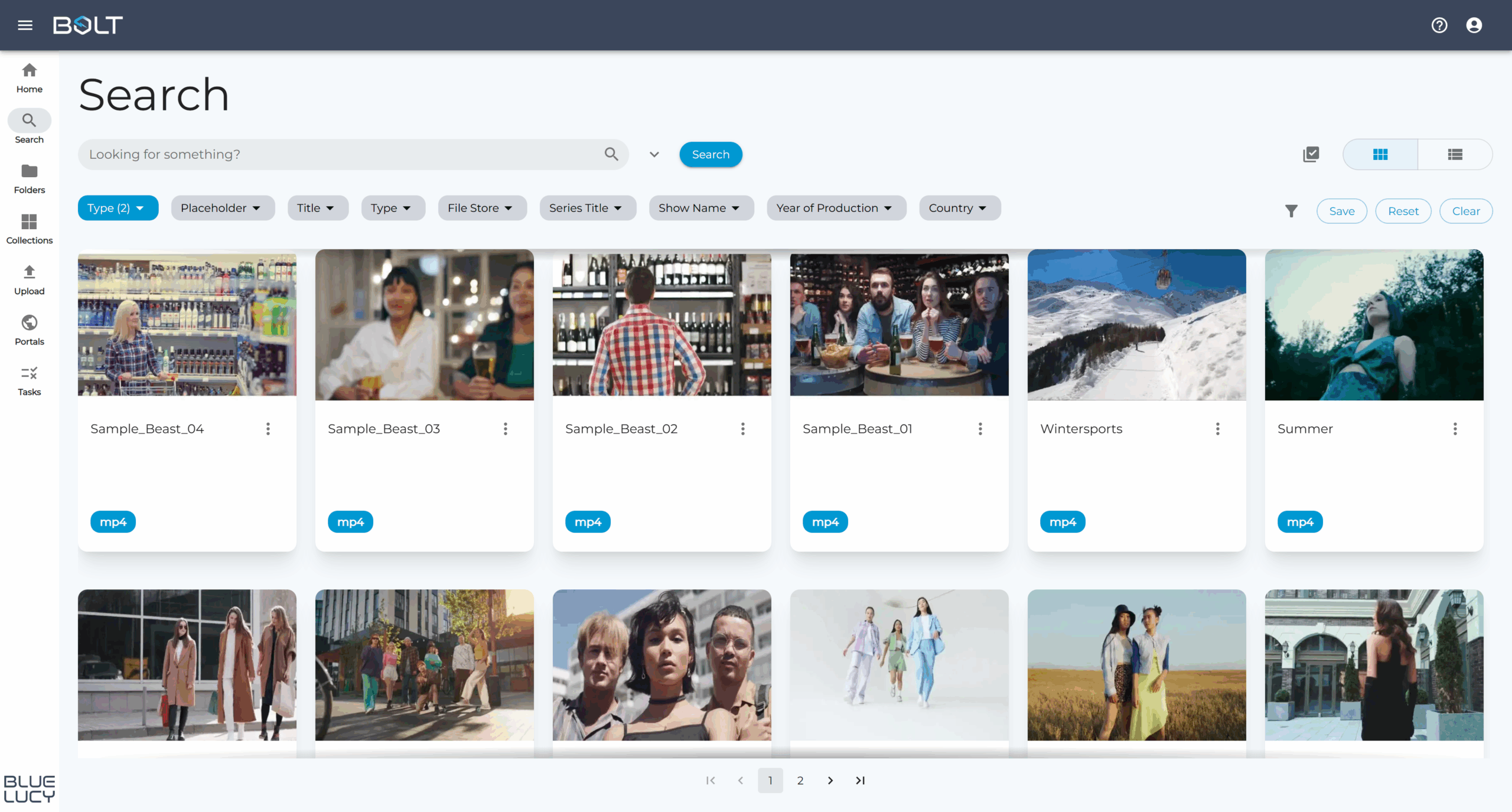
The BOLT Content Hub just got smarter. Our latest update brings a host of key improvements to help you work faster, collaborate better, and get more value from your content. Check out our Top 6!

Smarter Home Page

Your Home Page now puts what matters most front and centre:

  • Stay up to date – See recent uploads and activity at a glance.
  • Pick up where you left off – Quickly resume work on assets and collections.
  • Make it yours – Customise your Home Page for your workflow.
  • Search instantly – Jump straight into asset search from the Home Page.
Upload Portals

Collect content from external contributors securely and efficiently:

  • Easy setup – Create portals in a few clicks.
  • Full control – Manage access, expiry dates, and approved contributors.
  • Streamlined approvals – Workflows ensure files follow the right process.
  • Metadata at upload – Keep your library organised from day one.
  • On brand – Customise portal themes for a seamless contributor experience.
Accelerated Upload

Get files into BOLT faster and more reliably- content is discoverable and actionable the moment it arrives.

  • Built-in acceleration – No third-party licences needed.
  • Multi-part, multithreaded uploads – Speed through large files.
  • Optimised bandwidth – Smooth performance on any connection.
Version Comparison

Compare and manage versions with ease, and maintain accuracy and efficiency across your content library.

  • Sync playback – Compare previous and current versions side by side.
  • Quick uploads – Drag-and-drop new versions directly into assets.
Review and Approve

Collaborate and give feedback faster:

  • Mark and highlight – Draw attention to details and leave comments.
  • Timecode tracking – Link mark-ups to video/audio timestamps.
  • Customisable tools – Pick pen colours and undo mistakes easily.
  • Team visibility – View mark-ups from all users.
  • Broader support – Works on images and other non-video/audio assets too.
Subclips

Create and manage clips with precision. Repurpose and share content efficiently, without losing control or context.

  • Frame-accurate creation – Generate subclips from any video or audio.
  • Flexible rendering – Choose output options that fit your workflow.
  • Track relationships – See all subclips from the same parent asset.
  • Workflow automation – Send to YouTube, add intros, or configure custom processes.
Get in touch to explore how the BOLT Content Hub can make your workflows faster, smarter, and more connected.
By 0 Comments

Insights from the IBC Floor

Blue Lucy’s key takeaways from this year’s show: Attendance at this year’s IBC was apparently flat, and the numbers suggest market confidence is still a little fragile. But the show offered some fascinating opportunities for the Blue Team. It was a great to meet new industry professionals, take part in straight-talking panels, and feel the pulse of the industry.  Here’s what stood out:

YouTube, YouTube, YouTube

The phenomenal growth in YouTube viewing stats on Smart TVs has been well publicised and was the subject of much conversation on panels and on the show floor. If you don’t have a commercial strategy for YouTube you are missing a proven revenue stream and risk “slipping into irrelevance”.  Blue Lucy’s approach to YouTube, which allows operators to directly manage their inventories on the platform in the context of rights assertion and ensure take-down requests are adhered to, is nicely covered in our recent case study with Banijay Rights

FinOps is Fashionable

Well, not quite, but media companies are finding out that “cloud” in itself is not a strategy. CFOs are rightly paying closer attention to cloud costs, the operational benefits and tangible RoI – and are challenging some fashionable orthodoxies. FinOps has become a key function to ensure commercially sustainable operations, and it is becoming clear that hybrid models have a vital role to play in balancing flexibility and cost. For many media operations the most business-savvy strategy may be to sweat the assets that they have, and mitigate cost risk by migrating services to the cloud iteratively and validating the RoI as you go.  Blue Lucy’s project approach supports this model and delivers measurable value fast. Find out more about our iterative approach as point 6 in our earlier blog post.

Content Liquidity

We love this new term – well new to us anyway – as it embodies how we think about media supply operations. Our BLAM Content Factory helps unlock the commercial value of your inventory by providing highly configurable workflows to distribute your content on a huge range of consumer and intermediary platforms.  With hundreds of integrations, truly scalable automation, and fast to deploy capability the Content Factory delivers rapid time to value. Together with our BOLT Content Hub – a super simple to use content discovery platform – Blue Lucy delivers powerful business enablers.

    Now to carry on with the follow up trails and business-focused ‘proof of concept’ implementations.  Thanks again to Team Blue for a brilliant show, the insightful conversations, and the great shirts!

    By 0 Comments

    What NAB told us about the future of media tech

    This year’s NAB Show in Las Vegas marked a noticeable shift in the priorities of media and broadcast organisations. Gone are the days of chasing flashy, or “cool”, innovation for innovation’s sake. Instead, the conversations we had, and the interest in our solutions, made one thing clear: the industry is doubling down on practicality, efficiency, flexibility and value. As a technology partner, that message resonated with us. It validated our ongoing focus on delivering tools that don’t just push boundaries, but solve real-world challenges scalably, securely, and cost-effectively. Here are the key themes that shaped our NAB 2025 experience:

    Cost Control is Now a Strategic Priority

    Across the board, operational cost reduction has become the top agenda item. Many vendors push a “transformation” agenda but from users we heard most “measurable RoI,” “efficiency,” and “time to value.”

    Instead of massive technology overhauls, customers are prioritising targeted improvements with measurable outcomes. Our BLAM integration and orchestration platform is designed to support such an approach, streamlining operations without requiring wholesale change – BLAM stood out as a natural fit.

    Hybrid Cloud/Ground Is the New Norm

    The industry’s cloud conversation has matured. It’s no longer about choosing between on-prem or cloud, it’s about finding the right balance based on operational business need and cost. Organisations are increasingly adopting hybrid architectures that maintain critical workflows on-premises while using the cloud to when its more efficient or cost effective.

    Our platform was designed to support hybrid deployment from the outset and enables seamless integration across systems, services, and territories. 80% of our deployments are cloud-ground hybrid and deliver cost effective control, flexibility and scale.

    Integration Is Essential, Not Optional

    With consumer platforms seeming to grow exponentially across OTT, FAST, and social manual workflows simply can’t keep up.

    The benefit of automation is a given, but integration delivers more value through reduced friction, removing manual process, and providing end-to-end visibility. At scale operational efficiency is no longer a business benefit, it’s a survival requirement.

    Unlocking the Value of Content Archives

    Companies are looking to mine their legacy libraries for untapped value, especially in digital and on-demand markets.

    Our solutions support fast discovery, repackaging, and delivery through automation and easy to access tools.  Blue Lucy is helping customers monetise what they already have, without heavy lifting.

    Fast Value, Real Accountability

    Today’s buyers are sceptical of long, drawn-out transformation programs with vague promises and PowerPoint workflows. They want to see real value, fast.

    At NAB, we heard over and over how important rapid deployment, measurable results, and continuous improvement have become. Our approach is that we are a long-term partner in outcomes and continuous service, not just a provider of products.

    Empowering the Creator Economy Securely

    With content creation becoming more decentralised – and the creator economy exploding – organisations need to give teams secure, flexible access to content.

    Whether it’s internal creatives, freelancers, or partners, our platform ensures content is available wherever it’s needed, without compromising security or governance. That balance of ease of access and control is more critical than ever.

    Looking Ahead

    NAB 2025 confirmed what we’ve been hearing in conversations all year: innovation still matters, but it must be grounded in usability, agility, and value.  Blue Lucy is continuously building technology that meets those demands, today and into the future.

    By 0 Comments

    Saving money in the media supply chain

    6 RULES TO LIVE BY

    Arguably the top priority for media businesses in 2025 is to reduce operational costs. But that’s easier said than done when you’re faced with increasing content delivery demands for an ever-evolving consumer landscape. Based on our real-world experience working with international media organisations, we’ve put together six principles to help you save money across the content supply chain.

    1. You can’t monetise what you can’t see.

    There are vast libraries of unmanaged content running into the 10s of petabytes at a number of the big production labels – much of which isn’t even available as a browsable version. This media may as well not exist as you can’t monetise what you can’t see.  This is a common situation that’s increasing due to the significant M&A activity in the industry where multiple media catalogues have been combined from once separate production and distribution companies. But large volume content management is not an insurmountable problem. The first priority for any content owner or rights holder should be to bring everything under management so that you understand what content is in the library. Connect the MAM to the media, wherever it is, and have it register the material, generate a visible browse version, and hoover up as much metadata as you can find.  If there really is no data, a simple microservice program can automatically generate metadata based on the information contained in your filenames. You might be surprised by how far this will take you.

    2. Nobody move anything, until you know what it is.

    An end-to-end media supply chain is not synonymous with the cloud. Your media and the workflows involved in creating, managing and delivering content across various platforms and tools can be controlled and observable whether it’s in the cloud, on the ground (on-prem’) or any combination of the two. Bringing media under management doesn’t mean moving it to the cloud or anywhere else. Once you’ve registered the assets and made them visible  (see point 1 above) you can make an informed, value based, business decision as to where the most appropriate place is for them to be stored.  Too often we hear media execs talking about their cloud strategy rather than the business strategy and ‘the cloud’ as an outcome whereas it should be viewed as a component – albeit an extremely powerful component – of a business objective. 

    3. Clean as you go.

    Cloud services can deliver significant flexibility and efficiency. Equally, storing material in cloud storage has accessibility and security benefits.  But cloud storage is definitely not the least expensive option.  So, if you choose to migrate your content into the cloud, it’s worth getting your housekeeping done before you make the move.  First understand what you have, what condition it’s in, what the likely value is, and what rights you hold.  Other simple housekeeping tasks such as material deduplication or identifying minutes of colour black run out from a digitised tape, or camera pointing at ground rushes can also be carried out with the material in situ.  The 90’s broadcast engineers’ joke of operators inadvertently archiving hundreds of hours of colour bars isn’t quite so funny when you move from a $10/TB LTO to incrementally priced cloud storage.

    For this reason, we tend to support a controlled migration of content and workflows to the cloud rather than the ‘forklift content and sort it out when it gets there’ approach.

    4. You don’t need to shut down existing systems to modernise your operation.

    Your ‘legacy’ systems can, and probably do, still deliver value. There’s no need to change your entire technology ecosystem just because you want to introduce new tools, streamline your workflows or take advantage of cloud scale. In a constantly developing technology landscape, the best approach is to integrate, not deprecate. Your MAM orchestration platform should integrate with both legacy and new technologies so that existing systems can continue to deliver value while new tools – such as AI applications – can be readily incorporated into workflows to support ever changing business needs.  At Blue Lucy we achieve this by using our BLAM microservice architecture to connect disparate systems and enable a controlled migration to modern workflows.

    5. It doesn’t matter where the content is. No, really.

    The actual location of your content should have no bearing on your ability to monetize it. Your MAM should provide easy and uniform access to all your assets, no matter where the ops’ team or the media is physically located.  On-prem and cloud storage should be viewed interchangeably rather than one being for operations, such as fulfilment, and the other for the “safety copy” because your MAM ‘knows’ where the material is and can be configured to use the most appropriate repository. And, if your operation is all cloud, then the need for a “safety copy” is moot as the cloud vendor can provide multi-copy resilient storage through simple configuration.  80% of Blue Lucy BLAM deployments are hybrid and use both cloud and ground storage.

    6. Start small and work incrementally.                   

    Big bang “Transformation” projects are dead, and good riddance.  Big projects cost big money, carry big risk and often end up in big disappointment (when they’re not quietly killed).  Even the successful ones take a long time to deliver value, and the true RoI rarely moves the needle on the CFO’s dashboard, certainly after the long-departed big consultancy company fees are included.

    Instead, big projects can be delivered in small steps using modern service-based technology and open APIs.  That’s why we recommend focussing projects on end-to-end solutions for a thin, horizontal operational slice.  This approach proves the technology and the business case with minimal risk and delivers measurable value incrementally, building confidence with each slice and allowing a rapid change of direction if necessary. If your service provider or vendor can’t demonstrate value within 6 weeks of any project starting, you may want to reconsider working with them.

    Interested in learning how Blue Lucy’s BLAM and BOLT platforms can help you save money in 2025?  Get in touch!

    By 0 Comments

    BLAM vs BOLT: what’s in a name?

    Since its launch in 2020, Blue Lucy’s flagship product, BLAM, has also been the company’s only product. BLAM is a sophisticated workflow orchestration, system integration and media management platform, and both its core capability and the microservices which comprise its orchestration functionality have constantly evolved in that time. It has, however, remained Blue Lucy’s sole solution.  Until now.  At IBC 2024, Blue Lucy launched BOLT, a new product that’s described as a global gateway to content libraries for non-technical users. We asked Blue Lucy founder, Julian Wright, what prompted the decision to develop a new product and what distinguishes BOLT from BLAM.

    Q: Can you give us an elevator pitch overview of Blue Lucy, BLAM and BOLT?

    A : Blue Lucy’s ethos is to take an orthodoxy-challenging approach to solving media business problems.  Our core product, BLAM, is a sophisticated integration and orchestration platform designed to meet the complex and evolving business needs in production, localisation, and distribution. BLAM is an “enterprise” platform that serves the operational needs of multiple aspects of a media business.  Our new product, BOLT, is an operationally-simple offering designed to meet a fundamental, but most important, business need for any operation handling media assets – accessibility.

    Q: What was the initial motivation for developing BOLT?

    A : In BLAM deployments our implementation engineers and analysts tend to work with the media operations team within the ‘engine room’ of the operation.  In conversation with senior management teams, we were often surprised by statements along the lines of “your platform is great, the automation is really driving time to market and cost efficiency but at the executive level we would just like a really simple way to view our current inventory.” 

    Q : So, is BOLT simply a media portal for viewing content?

    That’s how it started, but it’s developed into more than that. On further examination, we uncovered a number of apparently simple requirements within the commercial business (i.e., outside of the technical content supply operation) that could be addressed by a toolset similar to BLAM.  Alongside the basic requirement to search and discover content is the ability to create showcases and viewing rooms and distribute these to sales prospects or internal marketing teams via secure links. Some customers want to create one or more branded ‘storefront’ portals to directly support sales or similar customer self-service functions.  On the subject of “portals” we saw a clear a common requirement within distributors to provide easy-to-use media upload portals to their production partners to allow them to push finished content and production metadata to the central content management and processing function.  This is particularly important to the aggregator distributors or production companies that hold a number of separate brands or labels under a broader umbrella.  BOLT satisfies all of these needs – it gives you effortless access to your content, provides an intuitive upload function and allows content owners to showcase and monetise content catalogues.

    Q: Many of these capabilities are available in BLAM – what makes BOLT different?

    A : All of these functions can be supported by BLAM as standard but as a collection of capabilities there was clearly a need for a commercially-focused product in its own right.  This is particularly the case in the overarching requirement that the tools needed to be easy to use – we took this one step further and defined the vision for the new product that it should have a zero-training requirement and be as intuitive to use as an on-line banking app – well the good ones at least.

    Q: Are BLAM and BOLT totally independent products?

    BOLT is built on the BLAM core technology and existing BLAM users may add the BOLT capabilities to extend the operational reach of their BLAM platform to support commercial and external business activities.  In this context, if BLAM is the engine room, BOLT is the viewing platform.  But BOLT is of course also available stand alone as a separate product.

    Your content inventory represents the most significant proportion of the value of your media business. To maximise that value, make it accessible with BOLT from Blue Lucy.

    Find out more about BOLT here or get in touch with the team to arrange a demo.

    By 0 Comments

    Introducing Lucia

    Everything you need to know about Lucia, BLAM’s new AI assistant.

    The Blue Lucy team introduced BLAM’s new AI assistant, Lucia to the media and entertainment industry at IBC Show 2024 in Amsterdam. And, while the application is still in development, the industry response to Lucia has been overwhelmingly enthusiastic, even earning the Blue Lucy team a TVBEurope Best of Show IBC 2024 Award. But, in a market flooded with AI messaging, what makes Lucia special and what difference will she make to BLAM users? We asked Blue Lucy’s head of product, Joshua Martin and Lucia’s primary developer, Aaron Leanage, to answer some frequently asked questions about Blue Lucy’s newest addition.

    Why did you create Lucia?

    At Blue Lucy we believe that technology needs to constantly evolve to keep up with the needs of the media and entertainment industry. This ethos is a big part of the reason why we built our BLAM platform on a microservice architecture, as it allows our team to develop and deliver new integrations and capabilities really quickly. But we wanted to explore how the latest AI developments could make it even easier for our customers to get value from the platform.

    Our goal was to lower the entry point to automation – so that customers don’t always need an engineer to create or manage processes or get answers to complex questions about workflows. Most operators can describe what they’d like the system to do, but not everyone has the time or capacity to learn how to access BLAM’s full functionality – Lucia was created to remove this barrier for our less technical users. Even typing is optional because Lucia responds to both text and voice prompts in conversational language, making BLAM accessible to almost anyone.

    What can BLAM users expect from Lucia?

    Lucia works alongside organisations’ predefined workflows to help with anything from simple searches to bulk actions and complex chained commands. Where workflows in BLAM are hard-coded to do things in a pre-defined way, Lucia provides flexibility for use cases that change from day-to-day.

    For example: if you’ve got a big batch of new content coming in and you need to generate placeholders, remove the bars and line-up and then save the media in a new storage folder, Lucia’s got it covered. And she remembers what you’ve asked her to do before, so it’s really easy to repeat processes or revise them without having to start from scratch.

    Some of the actions Lucia can take (which can be combined to create complex chained commands) include: asset searches, folder searches, creating placeholder assets, creating folders, attaching and detaching assets from workspaces or folders and getting metadata, workflow or user data.

    Besides automation, what other capabilities will Lucia provide?

    Because Lucia is based on a large language model (LLM) she can be used to perform tasks like summarising information, doing mathematical calculations, translating text and answering general questions that users may have about content formats, metadata and almost anything else – and you don’t have to leave the platform to find the information you’re looking for. Lucia can also be used as a business intelligence and support tool. You can ask her questions about your content and workflows, like how many assets are in a certain folder or whether any episode numbers are missing from a series of programmes, or get Lucia to perform calculations on data retrieved such as “get me all complete workflow runs completed in the last 24 hours and calculate the average runtime.”  This kind of information would previously only be available if the workflow had included a report generation process. 

    As Lucia is still in development, we’re still in the exploratory phase, establishing what the potential capabilities are and what would offer the most value to our customers. For example, if the AI assistant is integrated with BLAM’s data processing service, Lucia can use historic data to predict asset-based costs and identify workflow bottlenecks. Similarly, Lucia could rewrite BLAM user documentation in everyday language tailored to your operational context and answer users’ technical queries, cutting down on customers’ first-line support costs.

    Have there been any unexpected benefits?

    It quickly became apparent at IBC Show that different BLAM users would find value in Lucia for different tasks. So, while a user may be interested in asking her how to do something or creating bulk or chained operations, managers may find Lucia’s ability to summarise large amounts of data more useful and use her to find out how long it takes for workflows to be completed or how long it may take for a user to pick up a task. One of the unexpected benefits we’ve discovered is how Lucia could be used to optimise BLAM’s implementation, for example an administrator can use Lucia to identify which microservices need to be updated or to interrogate workflows to identify bottlenecks.   

    Is Lucia safe?

    Lucia can only add value to content or processes in BLAM. She can’t modify workflows or change the original assets, and she isn’t able to do anything that results in a loss of data. What this means is that, while Lucia can be used to create new versions of content, the original asset will remain intact and unchanged and, although the application can be used to build complex chained commands, she can’t interrupt or edit existing workflows. Lucia is also bound by the same user-permissions as the operator working in BLAM, so she can’t take any actions or access any information that the user isn’t already cleared for.

    When it come to keeping your data and content secure, Lucia uses your organisation’s AI provider, credentials and authentication so there can be no cross-contamination of data between BLAM customers, and Lucia will comply with any security agreements you have in place with your provider. The application currently runs in OpenAI’s ChatGPT and can be set up in Microsoft Azure’s Open Ai, but we plan to integrate Lucia with our customers’ choice of any large language model (LLM.)  

    When will Lucia be available in BLAM?

    Lucia is scheduled for general release to BLAM customers by the end of 2024.  Get in touch now to chat with the team about how Lucia might benefit your organisation or to arrange a demo. 

    By 0 Comments

    Reasons to be cheerful post-IBC…

    We’ve been mulling over our experiences at IBC last week and digesting some of the excellent reports and engaging sessions from the likes of Caretta Research, the IABM, and the IBC conference. It’s not Halloween yet, but they certainly made for chilling reading. There were 3 rather depressing major standouts for us, but it’s never all doom and gloom at Blue Lucy Towers…

    • Tech needs to either make money or save money.
      This is of course a universal truth, but it was a big theme at the show. Large scale multi-year broadcast infrastructure projects are as good as dead. Broadcasters’ profits are down, and job cuts are widespread. In this climate every £ and $ spent needs to be justified by rapid, tangible ROI, and projects need to be delivering value as they unfold, not at some point in the distant future. Our recent blog post outlines the Blue Lucy approach to rapidly delivering business value through iterative implementation. This project approach gives feedback at every stage and gives you opportunity to refocus when things change – you can read more here
    • Planned investment in 2025 is 14% lower than in 2024
      In such an uncertain business climate it’s no surprise that spending plans for next year are down. Projects that involve a wholesale replacement of tech will be fewer and further between. That’s why technologies that can integrate with existing, proven workflows and deliver further efficiencies will succeed. Integrate, don’t deprecate! Check out Blue Lucy’s integrations and get in touch to learn more.
    • It’s content that drives business KPIs for media companies, so tech spend is being squeezed.
      This is, frankly, as it should be but against this backdrop it’s little wonder that business confidence levels within the technology supply community are below 2022 levels. Many of the traditionally buoyant tech speciality areas are in decline, so why are we so bullish? Because our business continues to grow.  And because Blue Lucy has a toolset that allows media organisations to take a rapid, cost effective and genuinely low risk approach to operational transformation – be it in driving efficiency or exploiting new market opportunities with solutions such as BOLT, our new easy to use content portal.

    Want to explore how Blue Lucy can give you reasons to be cheerful in an uncertain business climate? Get in touch to find out more.

    By 0 Comments

    Strategies to Value

    How easy is it for large, broad scope projects to deliver actual business value?

    It’s a fact that our industry is littered with quietly, and not so quietly, abandoned big technology projects. Trade shows and networking events are frequently awash with talk of delays, cancellations and scope contractions for contracts that once grabbed the headlines. This begs the question: Has the industry lost sight of the importance of value? And how long is too long to wait for your technology initiatives to deliver tangible value to your organisation?  

    Here at Blue Lucy we are used to implementing integration projects at scale, and although we have some battle scars to prove it, we’ve learned a thing or two about delivering value along the way. We’ve put together 6 key strategies to mitigate the risks associated with large projects, and the first one is all about scope:

    • Don’t boil, slice:
      No, it’s not a cooking tip. It’s a technology and delivery approach that combines to allow projects to be implemented on the basis of the horizonal or vertical operational slice model. Here the supplier and management team work together to prove an end-to-end, or top-to-bottom operational capability that delivers value quickly. The project then continues on this operational slicing model with the next capability . The hackneyed phase “don’t boil the ocean” is overused, but it fits here. We believe it’s incremental slicing that delivers.

    When it comes to technology fundamentals, there is a stand-out model which has proven to be revolutionary in terms of faster development times, ease of deployment and ongoing business agility:

    • No-Code / Low-Code Development:
      You want to trial and test new operational pipelines and workflows, but you don’t want to wrestle with scripts or build a software development operation (Dev’ Op’).  You know there’s risk in developing and maintaining any software, even apparently simple scripts. You need to keep an eye on what’s right for the business and that includes reducing future liability. Working with no-code technology, your business analysts can build complex operational pipelines from a range of  microservices without requiring any software development knowledge. It’s simple, it’s fast, its adaptable, and proven.

    We’re in the midst of a media consumption revolution, and it’s key for media companies to exploit this effectively and quickly. Hoping that significant technology decisions will pay dividends when a major project completes two years hence is not a strategy, it’s a gamble. The project needs to be seen to be delivering as it unfolds:

    • Iterative Implementation:
      Iterative Implementations demonstrate earned value, and this approach delivers feedback at every stage of the project, including visibility of the effects of modifications, and the opportunity to refocus when things change, or go wrong. Your operational business needs are many, complex and evolving.  So choose a technology and vendor that enables a collaborative step-by-step approach. This in turn realises business value for you incrementally and at speed.

    When you have to manage business requirements from multiple stakeholders your technology choices become crucial:

    • Future-Ready Tech:
      Dig into the design philosophy of your technology candidates. Do they enable your vendors to deliver, evolve and support a solution that will keep delivering value to your business over the long term? Making the right choices at this stage of your project will empower you to tackle new business challenges and integrate with emerging technologies, ensuring long-term success for your business and a technical solution that stays relevant.

    To be far reaching and impactful, your project doesn’t have to incur pointless expense deploying all new solutions or to start from a ‘clean slate’. Why eradicate successful workflows, or replace fully operational solutions that are still delivering great value?:

    • Integrate, don’t deprecate:
      A modern, flexible platform will allow a media technology operation to be updated like Trigger’s Broom or, for the well-read, The Ship of Theseus. If you select a solution with hundreds of integration connectors for modern and legacy media platforms, you can keep the cost and disruption of implementations and iterations to a minimum.  The overall operation can be continuously updated with minimal impact and cost risk.

    The days are over when the executive would sponsor a big-bang multi-year project for which the ROI was years in the future. So, how do you effect change? Prioritise value, focus on relieving operational pains or making business gains, and work with a team that is as focussed on the value outcomes as you are. For our final point, it’s all about focussing on what counts:

    • Focus on the Value:
      In complex integration projects, it’s the project team that makes the difference between ‘good enough’ and ‘exceptional’. Great technology choices turn into outstanding deployments when the engineers are focused on getting you results, right from the start of the implementation. Work with a vendor who is focused on the difference their software can make to your operation. With joint focus, a shared vision, and a proactive approach, you’ll be able to derive value right from the outset. 

    In summary, here at Blue Lucy Towers we firmly believe that it should not be necessary to have to write any software to get value from a content management / supply platform, and that any such platform absolutely should be able to deliver end-to-end business value in less than six weeks. Try iterative strategies, move away from a waterfall approach, and focus on value. If you don’t, the outcome might be a solution that simply fixes yesterday’s problems, but not until tomorrow.

    By 0 Comments