Posts by:

Blue Lucy

Blue Lucy’s 6 Key Tenets

Modern media operations demand a platform that unites automation, orchestration, and human oversight without compromise. In this post, we explore the six key tenets that underpin Blue Lucy’s technically robust, extensible, and operationally efficient platform built for high-volume, complex workflows across hybrid environments.

1. Combine core capabilities

‘Static’ MAMs without workflow orchestration do not provide the level of automation required for today’s high-volume operations. Equally workflow orchestration platforms that lack a comprehensive MAM component are insufficiently nimble to support the complexity of a modern media operation. Automation platforms that neglect the human operations negate the efficiency they deliver. The Blue Lucy platform combines these core capabilities to deliver maximum efficiency, control, and visibility.

2. Microservices not monolith

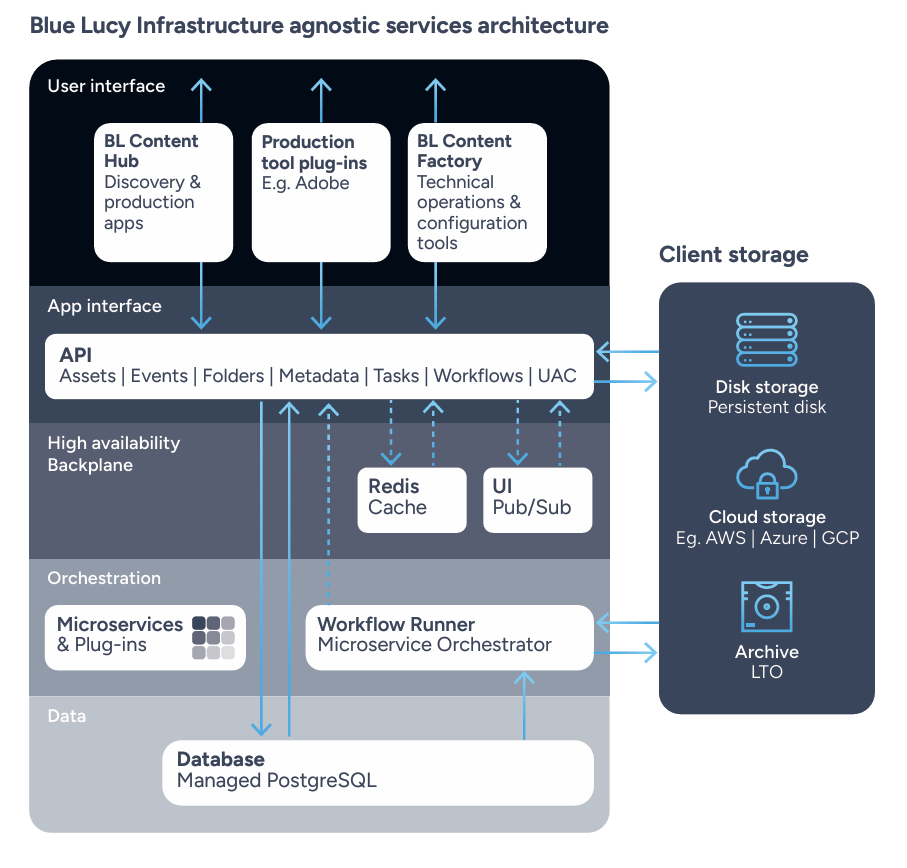
The Blue Lucy platform follows a distributed microservices architecture, meaning the overall functional capability is structured as a collection of loosely coupled services. The architecture is robust, resilient and conforms to the separation of concerns paradigm. The singularity of purpose is a key tenet and means the platform is easy to maintain and extend. It is comprised of more than 500 microservices which are orchestrated by the Workflow Runner service., making it the most readily extensible media integration platform.

3. No forking branches

Media is a complex operational business which has seen decades of evolution. There is an inevitable need for bespoke software components in all but the newest of operating models. It is still common for vendors to branch, or fork, the source code to create a version specific to a customer. This approach presents significant risk to operators. The platform has been structured so that Blue Lucy does not manage numerous code branches or build scripts for different customers. We have a single code base with customer specific bespoke microservices.

4. Integration, Integration, Inte…….

The most significant business value and operational gains come from integrated software and services. But operations built on supplier driven ‘ecosystem’ models are closed and are rightly described as vendor lock-in traps. Such approaches tend to work only as long as it commercially suits the members of the vendor cartel. The Blue Lucy platform has been designed to provide the integration layer between systems allowing technology abstraction whilst driving operational cohesion.

5. No code, low code, code

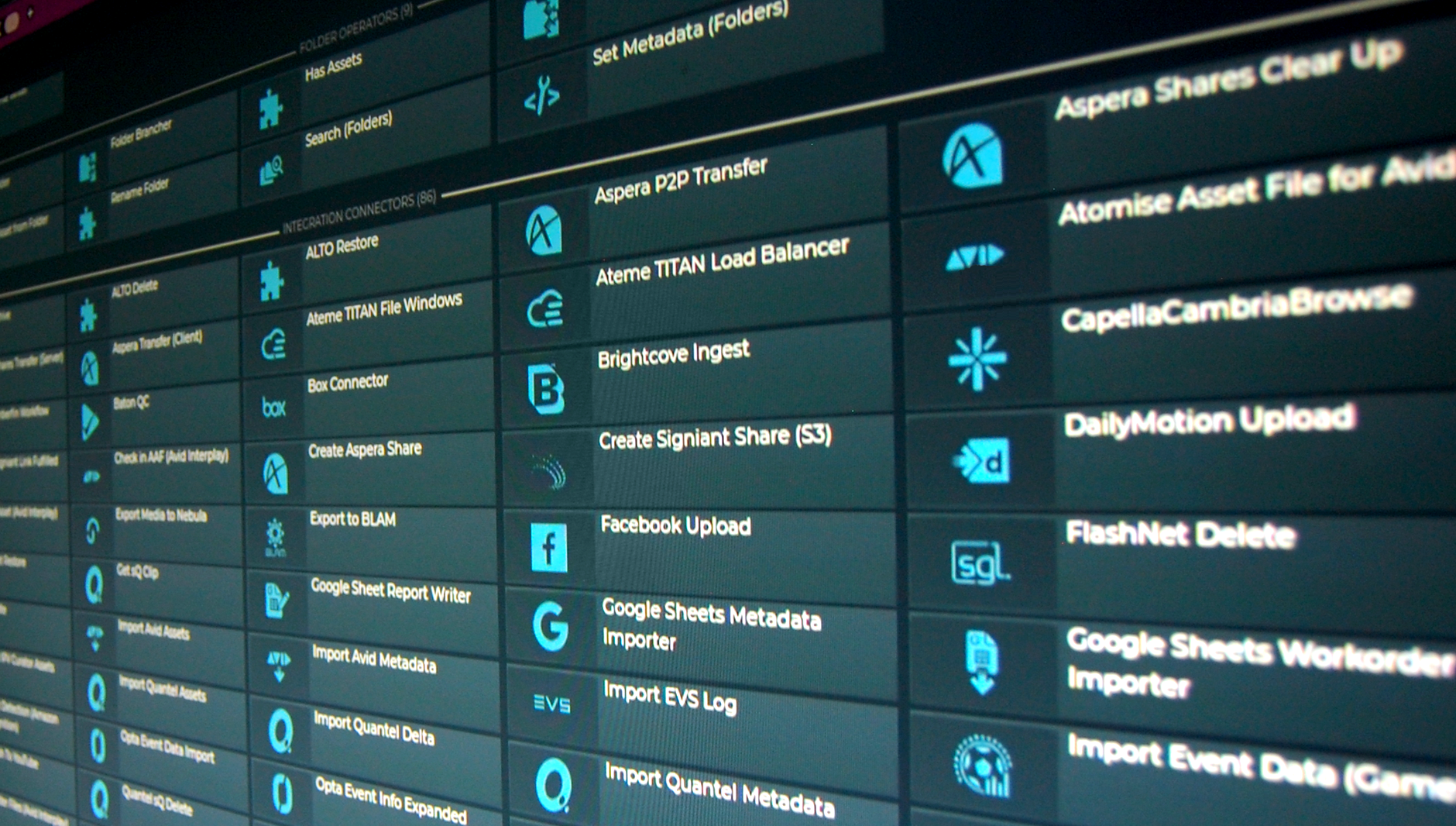
The platform has been designed to be accessible to operators with varying levels of business and technical expertise. It conforms to the ‘no-code’ paradigm and includes a drag-drop-connect-connect-configur e workflow builder, which is atomic, intuitive and means that business analysts can rapidly build and maintain complex operational workflows. In addition to the 500+ microservices the workflow builder allows secure scripting in C# or Python. Lower level, developer, access is provided through the API which is supported by an open SDK – the same SDK we use to develop the microservices.

6. Run anywhere

‘Cloud native’ sounds very modern, but binding an operational capability to the cloud, particularly specific cloud providers, is cloud dependent, the antithesis of the ethos behind the service orientated model. Equally media operations simply do not fit into an on-prem (ground) OR cloud model. Blue Lucy core services are containerised, and infrastructure agnostic enabling a controlled migration to the cloud or more typically a ‘hybrid’ cloud-ground deployment and operating model.

By combining extensible microservices, intuitive workflow orchestration, and hybrid deployment flexibility, Blue Lucy delivers a platform that empowers media operators to run complex workflows with control, visibility, and efficiency -turning technical sophistication into real-world operational impact.

By 0 Comments

NAB

The AI Wild West comes to NAB 2026 – and Blue Lucy is bringing the Sheriff

The AI Wild West is here, and media organisations are feeling the heat. On Booth W2318 we’ll be demonstrating how our orchestration platform enables you to take control of your content. We give you the tools to tame the chaos, by integrating the most appropriate AI models for each task, maintaining full auditability, and protecting brand trust.

We make AI usage visible, controllable and accountable, and we’ll be showcasing how broadcasters and media companies can accelerate AI adoption without scaling risk. Make your appointment now to secure your slot!

By 0 Comments

Has Video outgrown your DAM?

Digital Asset Management systems sit at the heart of most marcoms operations. They centralise content, organise it, and make it discoverable. Integrated with the wider MarTech stack, DAM support governance and drive efficiency. But video has changed the brief.

Video is no longer an occasional campaign asset. It is now the dominant content format across marketing, product, internal communications, and customer engagement. And as volumes grow, so do the operational pressures.

The issue is not whether your DAM can store video.
The issue is whether your teams can discover, reuse, adapt, and govern it efficiently at scale.

Because when discovery slows, reuse drops.
And when reuse drops, costs rise – often without anyone noticing.


Video Is ‘Just Another File’ – Until It Isn’t

At a basic level, a video file is simply another digital asset. A DAM can store it, catalogue it, and apply metadata to it. But video carries characteristics that fundamentally change how it needs to be managed:

  • Format complexity. Video comes in a wide range of encoded formats (CODECs), each with different configurations – frame rates, encoding structures, audio arrangements. These aren’t cosmetic differences; they directly affect compatibility, quality, and approach to distribution.
  • File size and accessibility. Professional video files are large and often not web-browser compatible. That makes previewing, streaming, and collaboration harder within systems designed primarily for static media.
  • Time-based structure. Unlike images, video unfolds over time. Metadata doesn’t just apply to the whole asset – it applies to specific periods within it.
  • Localisation and variants. Subtitles, audio stems, regulatory edits, regional variations – these are related and often interdependent components, not just new versions of the same file.
  • Derivative creation. Social cutdowns, vertical edits, different durations – all need to maintain lineage back to the master asset to avoid duplication and rights infringements.
  • Ongoing editing cycles. Video assets are routinely adapted long after creation or first publication. Their lifecycle is longer, dynamic and continuous.

And perhaps most importantly, Creatives and marketers are rarely searching for a file.
They are searching for a moment – a product shot, a quote, a scene, a reaction. That distinction is where traditional DAM models begin to strain.

Finding the Right Moment – Not Just the Right Asset

Metadata has always powered discovery inside DAM systems. This object-based metadata – be it campaign, product, spokesperson, usage rights – works well when assets are static.

But video exists in two dimensions:

  • Catalogue metadata – information about the asset as a whole.
  • Temporal metadata – information tied to specific time periods within the asset.

A tag might say “Product X is in this asset,” but it won’t say whether that appears in the first five seconds or the last thirty. It won’t tell you if the segment you want to use is already in use elsewhere, or the rights have expired. That lack of clarity increases risk and kills efficiency.

At a small operational scale, teams can compensate with knowledge (memory), spreadsheets, and manual review.

At enterprise scale – across regions, agencies, languages, and campaigns – that approach quickly breaks down.

When discovery doesn’t deliver, teams instinctively create their own workarounds: local edits, shared folders, private versions – bypassing the DAM because it doesn’t give them what they need when they need it. That behaviour isn’t just inefficient, it erodes governance, inflates production costs, and reduces RoI from existing content.ntent.

The Hidden Cost of “Making It Work”

Most modern DAM platforms support video in some form. Many do so capably within the limits of their original design. But “supporting” video often means adapting workflows around a model designed for static assets.

That adaptation typically looks like:

  • Additional tools bolted on around the DAM
  • Manual reformatting and distribution processes
  • Workarounds for preview and playback
  • Fragmented metadata across systems
  • Disconnected rights tracking

Individually, these compromises feel manageable.
Collectively, they create friction — and friction increases exponentially as content volumes grow.

Managing Video Requires a Shift in Perspective

The real question isn’t: “Can our DAM store video?” It’s: “Are we managing video on its own terms?”

What’s emerging is not a rejection of DAM, but a more nuanced ecosystem:

  • DAM remains essential for governance, brand control, and enterprise-wide visibility.
  • Video-native systems handle time-based metadata, format complexity, version control, and high-volume processing.
  • Integration ensures both operate cohesively rather than competitively.

Savvy teams are not looking for a monolithic “silver bullet.” They are rethinking their architecture so that each specialised system – DAM, video indexer, transcoder, rights engine – contributes a distinct capability. The task then becomes enabling systems to collaborate, not forcing one to do everything. That mindset separates high-performing teams from those stuck patching processes.

Lessons from Media & Entertainment

These challenges are not new.  The Media & Entertainment sector has been solving them since the late 1990s through Media Asset Management (MAM) systems. For broadcasters’ manual processes were never viable.

Operating efficiently required:

  • Structured, time-aware metadata
  • High levels of automation
  • Tight integration between production and business systems
  • Clear orchestration across ingest, edit, versioning, and distribution

As corporate video demand begins to reach broadcast volumes, marcoms teams are encountering similar pressures, often without the infrastructure on which professional media organisations rely.

Automation Is No Longer Optional

With content demand chains growing exponentially, manual operations are becoming infeasible – even for mid-sized With marcoms content demand chains growing rapidly, manual operations are becoming infeasible – even for mid-sized teams.

Video management at scale requires orchestration:

  • Automated transcoding into multiple formats
  • Structured version control
  • Omni-channel distribution
  • Integrated rights and compliance management

Adjacent to automation is the need to reduce friction between systems. Modern media systems such as the Blue Lucy platform are built with structured integration frameworks designed to connect production tools, DAMs, and business systems efficiently.

Because the real risk isn’t just storage capacity.
It’s operational complexity, and the erosion of value from content you’ve already invested in creating.

The Real Challenge

Video is now the dominant marketing medium. Storing it is easy. Managing it intelligently – discovering moments, reusing content, coordinating derivatives, and maintaining governance at scale – is the real challenge.

Organisations that recognise this shift early are building integrated, automated video operations designed for growth.
Those that continue adapting static systems to dynamic media will find the friction, and the cost, only increases over time.

By 0 Comments

The AI Wild West, and Why it Needs a Sheriff

AI Is Scaling Faster Than Governance – And That’s a Risk

AI adoption hasn’t rolled out through neat transformation programmes. It has spread organically, driven by teams trying to move faster. It’s already embedded across newsrooms, marketing departments, communications teams, HR, legal and strategy functions. Often informally, and often without central oversight.

A producer indexes archive footage using an AI tool. A marketing team analyses sentiment. An editor runs a clip through a model to check for profanity.

Each action feels efficient, helpful, low risk. But collectively, they create something most organisations aren’t prepared for: AI embedded in core workflows without visibility, control or traceability.

Where did the data go? Which model was used? Was the output reviewed? Were any rights unintentionally waived in the process?

In many cases, no one has a complete picture. AI hasn’t outpaced governance because organisations are careless. It has outpaced governance because the tools are frictionless – and governance isn’t.

Reputational Risk Now Moves at Machine Speed

The reputational equation has fundamentally changed.

One hallucinated output. One biased summary. One automated decision that shouldn’t have been automated.

And it can be published, shared and amplified instantly.

For media organisations in particular, this is high stakes. Publishing misinformation is damaging enough. Publishing it at machine speed, with unclear accountability, compounds the impact. When something goes wrong, the questions are immediate:

Was AI involved? Was it checked? Who approved it?

If those answers aren’t clear and defensible, credibility takes the hit. AI doesn’t just scale productivity. It scales exposure.

Regulation Is Accelerating – and Accountability Is Personal

At the same time, regulation is catching up quickly. New frameworks demand transparency, oversight and traceability in AI-assisted decisions and content production. Executives are accountable, even when outputs are generated by third-party models. Yet many organisations cannot currently evidence which model produced a specific output, what data informed it, what safeguards were applied, or how the output was reviewed before release.

Policies may exist. Ethical principles are often well articulated. But unless they are embedded in operational systems, they don’t provide protection. The gap between intent and implementation is where risk lives.

Speed Versus Safety Is the Wrong Debate

There’s a perception that governance slows innovation. In reality, the absence of governance creates far greater friction later: retractions, investigations, legal exposure and long reputational repair cycles.

If AI was adopted to improve efficiency, reconstructing an audit trail across multiple disconnected tools defeats the purpose. Manually piecing together who used what, where and how is both time-consuming and unreliable.

The smarter approach is to embed governance directly into the workflow – so it happens automatically, not retrospectively. That’s where managed orchestration becomes critical.

Orchestration: Bringing Control to AI at Scale

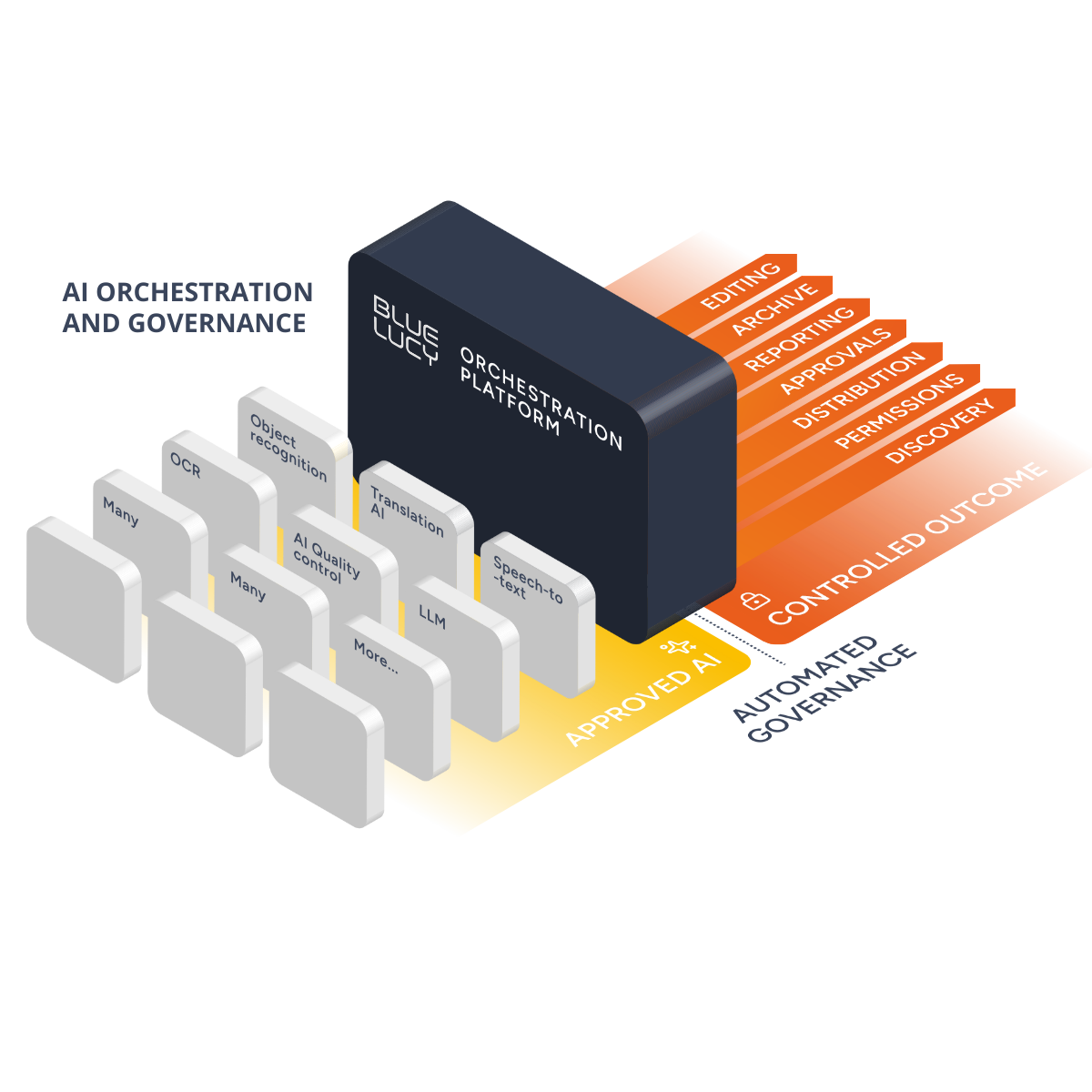
What organisations need isn’t just access to AI models. They need control over how those models are selected, used and reviewed.

At Blue Lucy, we’ve focused on building that management layer.

Our orchestration engine has direct integration connectors to multiple AI service providers and platforms allowing millions of models to be accessed and controlled within a single platform. This allows organisations to choose the most appropriate model for each use case – whether that’s transcription, summarisation, compliance checking or content enhancement – while maintaining absolute control over access and usage.

Traceability is built in.

If AI generates part of a clip, that segment can be flagged for enhanced editorial scrutiny. The prompt can be stored. The model used is recorded. The approval process is logged. An electronic and accessible audit trail exists by default, not as an afterthought.

This isn’t about embedding a limited number of models and hoping they cover every requirement. It’s about enabling organisations to use the best-fit models for their business in a way that is governed, auditable and aligned with their risk profile.

This approach enables your operation to move AI from experimentation to enterprise-grade implementation.

Trust Is the Competitive Advantage

For media brands, trust is the product. Audiences, clients and regulators are increasingly asking the same questions: Was AI involved? Was it checked? Who is responsible?

Being able to answer clearly and confidently isn’t just a compliance exercise. It’s a commercial advantage.

The organisations that will win in this next phase of AI adoption won’t be the ones who moved fastest. They’ll be the ones who scaled responsibly.

Control your inputs. Audit your outputs. Integrate AI intelligently. Embed governance.

Because while AI accelerates value, without the right management layer it drives risk just as quickly.

Some commentators describe the current landscape as ‘the AI Wild West’ – in that context the winners will be those with sufficient sheriffs, not the fastest guns.

By 0 Comments

DAM Los Angeles

Video moves fast – can your DAM keep up?

Join Blue Lucy in LA for the West Coast’s leading Digital Asset Management event as we explore, celebrate, and accelerate The Intelligent Evolution of DAM.

Video isn’t just one more content format for your marketing function: it’s the dominant force driving engagement, brand awareness and sales.

Meet us at DAM LA to explore how our platform enables teams across the business to discover, manage, review, and publish video content in a way that’s straightforward, reliable, and ready to go.

By 0 Comments

Building a unified, secure localisation operating model with Blue Lucy

When VSI Group, one of the world’s leading localisation providers, set out to modernise its complex, multi-site operations built through years of acquisition and growth, the challenge was to achieve both security and scalability while streamlining critical workflows across the business.

Handling vast amounts of sensitive, time-critical content for major studios and streaming platforms demanded automation, traceability, and accountability at every stage.

Partnering with Blue Lucy, VSI implemented the BLAM Content Factory, the highly configurable workflow orchestration and media asset management platform that securely automates and audits content operations. The result is a unified, high-volume operation that empowers VSI’s project teams to manage, track, and deliver content efficiently, confidently, and at scale.

Since deployment, VSI has achieved measurable gains in speed, security, and visibility – processing over two million automated service executions per month and increasing overall media throughput by over 50%.

The Challenge

Over more than three decades of growth, VSI Group’s localisation operations had evolved. As the company expanded into new regions and services, the underlying systems multiplied. “As we expanded our footprint, we acquired lots of different systems doing small tasks,” recalls Pete Lewis, Group Studios and Systems Director at VSI. “We needed a solution that could consolidate multiple, complex systems into a more streamlined, unified process.”

Each system worked in isolation, with no centralised system to track or log assets. Files were handled manually, stored on disks and network folders, and transferred via user-dependent processes.

“We wanted to make security core to our management and transfer of assets,” says Pete. “Having an automation system like the BLAM Content Factory meant we could disconnect the user from the media but still carry out what used to be manual tasks automatically”.

With global clients demanding ever-tighter turnarounds – sometimes within 24 hours – and security requirements rising across the industry, VSI needed a solution that could automate, secure, and scale its localisation workflows.

Who are VSI?

Founded in 1989, VSI Group is a global leader in localisation, adapting film, TV, and multimedia content for audiences around the world. Operating through a network of studios across major territories, VSI provides end-to-end services including dubbing, subtitling, translation, and media processing for clients ranging from major Hollywood studios to leading streaming platforms.

“The streamers of the world – Netflix, Amazon, Disney – have driven the demand for high-quality localisation,” says Pete. “They require content to go live in all languages on the same day. That’s where automation has become essential.”

From Fragmentation to Flow

Before implementing BLAM, VSI’s workflows relied on a patchwork of tools and self-developed software.

Recognising the need for a unified system, VSI conducted a wide-ranging technology review, assessing around 30 MAM solutions. “So many of them did parts of what we wanted,” says Pete. “But what stood out about Blue Lucy was that whatever we wanted to do, it was possible. There was nothing we were told ‘can’t be done’.”

The microservice-based architecture of BLAM was another key factor: “Being able to build things out of microservice agents was much faster when compared to scripting or workarounds.”

The Blue Lucy Solution

Working closely with VSI, Blue Lucy configured the BLAM Content Factory to match VSI’s complex localisation workflows and security requirements. The platform provided:

  • A customised user interface built around VSI’s operator preferences
  • Automated ingest-to-delivery workflows spanning file transfer, transcoding, subtitling, and text-to-speech dubbing
  • A bespoke virtualised folder structure aligned with VSI’s project logic, simplifying discovery and work-in-progress operations
  • Integrated watermarking and audit tracking for security and traceability
  • Secure, trackable vendor exchanges, eliminating manual ‘shipping’ processes

As VSI’s business has evolved, the platform expanded to integrate with more third-party systems, including OOONA, transcription services, and subtitle validation tools.

“We’re adding integrations all the time,” says Pete. “Some are small touch points that inform another system something’s happened, others are new services altogether. The upshot is we can process and handle more media, faster, with less human intervention.”

During workflow design, VSI’s teams quickly realised how many previously manual steps could be eliminated. “Originally, we’d planned for people to enter data or trigger stages manually,” Pete explains. “But we discovered the system could handle that automatically. Users just select what they want and where it goes, press a button, and off it goes. No one in the back end needs to do anything at all.”

Results and Impact

Since the initial deployment in 2022, the BLAM Content Factory has transformed VSI’s operational landscape.

  • 50% increase in throughput without additional headcount
  • 2,000+ assets ingested and delivered daily
  • Around 30 connected systems, both internal and third-party
  • More than two million microservice agent executions monthly

“Because we can handle more media faster and with less human intervention, we are able to scale more rapidly,” says Pete. “We can meet deadlines faster and handle larger volumes of content.”

Crucially, security has been elevated to a new level. “No one actually sees anything until it’s in the system,” Pete explains. “We treat every project, whether a theatrical release or a YouTube short, with the same high security. Using BLAM Content Factory makes that simple.”

Reliability has been another major success factor. “The platform is robust” says Pete. “If there’s ever a hiccup, Blue Lucy fixes it. There’s never a ‘known bug you have to live with’. That’s been seriously important for us because our operation runs 24/7.”

Looking ahead, VSI plans to expand the BLAM Content Factory across all VSI international offices, establishing a central repository of media and metadata, and integrating AI-driven automation and analytics. “Outputs from AI services will be stored with the asset in BLAM,” says Pete. “It’ll make them searchable and reusable for further processes.”

Outcomes at a Glance
  • Unified, automated global workflows
  • 50% increase in media throughput
  • Secure, auditable operations
  • 24-hour turnaround capability
  • Global rollout planned across all VSI sites
  • Foundation in place for AI-driven metadata and automation
“Rewarding” Collaboration

Pete describes the partnership with Blue Lucy as both practical and creative:

“It’s rewarding because there never seems to be a problem. The attitude is always, ‘We’ll find a way to do that.’ We’ve got some pretty esoteric workflows. We’re not a channel, and every client has their own naming conventions and workflow differences, but the BLAM Content Factory handles it all. The system just works.”

VSI renewed its partnership with Blue Lucy in November 2025.

By 0 Comments

Blue Lucy Renews Multi-Year Partnership with VSI Group

LONDON, England –  November 11, 2025 – Blue Lucy, a leading provider of media management and workflow automation solutions, is pleased to announce the renewal of its relationship with the VSI Group, a leading global localisation provider. This new multi-year agreement further extends the platform within VSI’s global studio network, which covers 22 territories and supports high-quality dubbing, subtitling, and localisation services in multiple languages.

Founded in 1989, VSI adapts content for audiences worldwide. Localisation projects are often time-sensitive, requiring simultaneous delivery across multiple regions to avoid spoilers and maintain a consistent viewing experience. The Blue Lucy BLAM Content Factory automates and streamlines these workflows, providing secure, reliable, and auditable content management throughout the production lifecycle. Since the initial deployment in 2022, the platform has been expanded to increase regional coverage and has been integrated with several third party applications and services including file transfer tools, storage mediums, content reformatting, subtitling and dubbing technologies. These integrations and business logic are orchestrated via bespoke operational workflows, delivering a high efficiency, high quality operation for VSI and its customers.

The deployment automates content management using logic, which is tailored to VSI’s business operation, ensuring project managers can quickly locate materials, prepare them for vendors, and deliver back to clients efficiently and securely. Automated processes track every step, including watermarking and secure transfers, reducing error and maintaining accountability for sensitive content.

Speed, reactivity and security are crucial in localisation,” said Blue Lucy’s Jonathan Lunness. “At VSI, the BLAM Content Factory ensures content is prepared, tracked, and delivered securely at scale. In fact, this is one of our busiest deployments. We’re delighted that VSI chose to extend the contract and look forward to working with them as the business evolves to leverage emerging technologies including a deeper application of AI in the coming months and years.”

Pete Lewis, Group Studio and Systems Director at VSI added:
VSI works on top tier content on behalf of the world’s largest broadcast and streaming providers. With the support of the Blue Lucy BLAM Content Factory, VSI is able to securely manage and track assets throughout the entire production lifecycle, processing and delivering millions of sensitive media files where they are needed, efficiently, quickly and at scale. We are proud to continue our longstanding partnership with Blue Lucy and look forward to further innovation and collaboration to help develop deeper AI functionality, which will realise greater efficiencies for our clients”.

About VSI

VSI provides language localisation and media services, including lip-sync dubbing, voice-over, subtitling, translation, transcreation and more, in over 80 languages worldwide. Founded in 1989 and headquartered in London, VSI owns and operates 24 studio facilities across Europe, the US, the Middle East and Latin America, together with teams in Asia. VSI works across a wide range of sectors, from broadcast, VOD, theatrical and gaming to corporate and creative. Find out more at vsi.tv.

By 0 Comments

What’s New in the BOLT Content Hub?

The BOLT Content Hub just got smarter. Our latest update brings a host of key improvements to help you work faster, collaborate better, and get more value from your content. Check out our Top 6!

Smarter Home Page

Your Home Page now puts what matters most front and centre:

  • Stay up to date – See recent uploads and activity at a glance.
  • Pick up where you left off – Quickly resume work on assets and collections.
  • Make it yours – Customise your Home Page for your workflow.
  • Search instantly – Jump straight into asset search from the Home Page.
Upload Portals

Collect content from external contributors securely and efficiently:

  • Easy setup – Create portals in a few clicks.
  • Full control – Manage access, expiry dates, and approved contributors.
  • Streamlined approvals – Workflows ensure files follow the right process.
  • Metadata at upload – Keep your library organised from day one.
  • On brand – Customise portal themes for a seamless contributor experience.
Accelerated Upload

Get files into BOLT faster and more reliably- content is discoverable and actionable the moment it arrives.

  • Built-in acceleration – No third-party licences needed.
  • Multi-part, multithreaded uploads – Speed through large files.
  • Optimised bandwidth – Smooth performance on any connection.
Version Comparison

Compare and manage versions with ease, and maintain accuracy and efficiency across your content library.

  • Sync playback – Compare previous and current versions side by side.
  • Quick uploads – Drag-and-drop new versions directly into assets.
Review and Approve

Collaborate and give feedback faster:

  • Mark and highlight – Draw attention to details and leave comments.
  • Timecode tracking – Link mark-ups to video/audio timestamps.
  • Customisable tools – Pick pen colours and undo mistakes easily.
  • Team visibility – View mark-ups from all users.
  • Broader support – Works on images and other non-video/audio assets too.
Subclips

Create and manage clips with precision. Repurpose and share content efficiently, without losing control or context.

  • Frame-accurate creation – Generate subclips from any video or audio.
  • Flexible rendering – Choose output options that fit your workflow.
  • Track relationships – See all subclips from the same parent asset.
  • Workflow automation – Send to YouTube, add intros, or configure custom processes.
Get in touch to explore how the BOLT Content Hub can make your workflows faster, smarter, and more connected.
By 0 Comments

Insights from the IBC Floor

Blue Lucy’s key takeaways from this year’s show: Attendance at this year’s IBC was apparently flat, and the numbers suggest market confidence is still a little fragile. But the show offered some fascinating opportunities for the Blue Team. It was a great to meet new industry professionals, take part in straight-talking panels, and feel the pulse of the industry.  Here’s what stood out:

YouTube, YouTube, YouTube

The phenomenal growth in YouTube viewing stats on Smart TVs has been well publicised and was the subject of much conversation on panels and on the show floor. If you don’t have a commercial strategy for YouTube you are missing a proven revenue stream and risk “slipping into irrelevance”.  Blue Lucy’s approach to YouTube, which allows operators to directly manage their inventories on the platform in the context of rights assertion and ensure take-down requests are adhered to, is nicely covered in our recent case study with Banijay Rights

FinOps is Fashionable

Well, not quite, but media companies are finding out that “cloud” in itself is not a strategy. CFOs are rightly paying closer attention to cloud costs, the operational benefits and tangible RoI – and are challenging some fashionable orthodoxies. FinOps has become a key function to ensure commercially sustainable operations, and it is becoming clear that hybrid models have a vital role to play in balancing flexibility and cost. For many media operations the most business-savvy strategy may be to sweat the assets that they have, and mitigate cost risk by migrating services to the cloud iteratively and validating the RoI as you go.  Blue Lucy’s project approach supports this model and delivers measurable value fast. Find out more about our iterative approach as point 6 in our earlier blog post.

Content Liquidity

We love this new term – well new to us anyway – as it embodies how we think about media supply operations. Our BLAM Content Factory helps unlock the commercial value of your inventory by providing highly configurable workflows to distribute your content on a huge range of consumer and intermediary platforms.  With hundreds of integrations, truly scalable automation, and fast to deploy capability the Content Factory delivers rapid time to value. Together with our BOLT Content Hub – a super simple to use content discovery platform – Blue Lucy delivers powerful business enablers.

    Now to carry on with the follow up trails and business-focused ‘proof of concept’ implementations.  Thanks again to Team Blue for a brilliant show, the insightful conversations, and the great shirts!

    By 0 Comments

    IP is everything

    How BLAM supports Banijay Rights in protecting and monetising their intellectual property across global platforms

    With a catalogue that spans more than 200,000 hours of stand-out programming, from Peaky Blinders and MasterChef to Big Brother and Black Mirror, Banijay Rights is one of the most influential content distributors in the world. As part of global content powerhouse Banijay Entertainment, the company manages rights and revenue across an intricate web of broadcasters, platforms, and formats.

    As the distribution landscape expands, so does the challenge of protecting and monetising valuable intellectual property (IP). Banijay Rights turned to Blue Lucy’s BLAM platform to evolve its workflows from legacy systems to a scalable, integrated solution that streamlines delivery and supports IP protection at every step, even after the content has ‘left the building’ and been published to social media platforms.

    The Challenge: Volume, Value, and Visibility

    With growing demand for content to be published on an ever-increasing range of consumer platforms Banijay Rights needs to be able to react quickly to commercial opportunities and distribute content in multiple formats on social platforms, FAST channels and VOD services.

    Banijay Rights had outgrown the company’s previous in-house system and with the range of formats and delivery platforms expanding rapidly, a new solution was urgently needed to handle both full episode and clip publication.

    Enter BLAM: Fast, Automated, Integrated

    Banijay Rights chose to utilise their BLAM platform, which was already managing their broadcast media supply chain, for social media platform publishing and content claiming.  BLAM now powers a substantial amount of Banijay Rights’ social media and VOD delivery, including high-volume workflows to Amazon Prime Video Direct. But its value lies in more than delivery speed, it’s also about data integrity, IP protection and revenue tracking.

    “From the point of publishing, we’re automating and using internal IDs and structures so that when we get information back from platforms we know exactly what revenue should be allocated back to what title.” says Richard Clarke, Head of Content Operations at Banijay Rights.

    This automation is possible because BLAM integrates directly with Banijay’s rights management platform, allowing custom IDs and metadata to flow from source systems through to publishing.

    “You can’t get content onto YouTube without having the correct IDs from BLAM. It’s automated through the publishing workflows. You can’t get it wrong,” he confirms.

    Claiming content before it hits the feed

    Once content is live, BLAM continues to add value, supporting Banijay Rights’ extensive IP protection workflows with YouTube and Facebook’s content claiming tools.

    “Once a title leaves the BLAM environment, it’s not forgotten,” states Clarke.

    As a YouTube Studio trusted partner, Banijay Rights uses the Copyright Match Tool to track uploads of its content carried out by external parties. Identified content can either be removed from the platform if found unsuitable and painting a title in a bad light, or ownership claimed by Banijay Rights who will then receive any associated monetisation

    Content claiming policies are highly specific, tailored to territories, rights agreements and titles, and set up by the team using BLAM’s dynamic workflows. “Our team is presented with a drop-down list of all the various policies within the BLAM UI.   Our team can, for example, upload 10 episodes of MasterChef Albania, along with the season’s specific copyright policy, so that everything is in place before the first episode airs.”

    Most importantly, this happens fast. “Ideally before transmission,” says Clarke, “You want content claiming in place before anyone’s even got access to the content, so as soon as somebody uploads the first clip, we can assert our rights.”

    Built for scale – and what’s next

    As the business of distribution evolves, Banijay Rights is ready. With BLAM at the heart of its publishing and IP workflows, the company has streamlined operations and ensured future scalability, even as new platforms and formats continue to emerge.

    “VOD distribution’s always on the rise. We already have integrations with Roku, Pluto, Hulu, Tubi and so on, and with BLAM we’re able to manipulate our metadata and deliver in the way that each platform wants.”

    And with growing support for FAST, monetised social video and new delivery models, the Banijay Rights team is keeping one eye on the horizon and on the tools that will help get them there.

    “We’ve already partnered with Samsung, Amazon, Amagi… that’s a huge selling point. Any business that has a load of content just wants to plug something in and start getting it out the door.”

    Looking ahead, there’s even excitement around how Blue Lucy’s work with AI might enhance the offering: As Clarke says, “We’re excited to see what Blue Lucy does with AI.”

    Quick View: BLAM at Banijay Rights

    Company: Banijay Rights
    Challenge: Content delivery and rights management of its catalogue
    Solution: BLAM – Blue Lucy’s orchestration and integration platform
    Impact:

    • Over 1,000 hours/month to Amazon Prime Video Direct
    • Around 500 hours per month delivered to Tubi
    • More than 5,000 unique clips and compilations (C&Cs) posted, and almost 10,000 reference files uploaded in the first 7 months of 2025 *
    • Fast, automated uploads to YouTube, Facebook and more
    • Metadata-driven royalty reconciliation
    • Proactive, policy-based IP protection
    • Minimal downtime, maximum scalability

    *These stats capture Banijay Rights’ posting done via its London office alone. They exclude posting which takes place under its instruction from partners in local markets, as well posting across the wider Banijay Entertainment Group and partners.


    By 0 Comments